Best Solid Hardwoods (White Oak vs Walnut vs Pine) for Non-Sag Shelves
Selecting the best Solid Hardwoods (White Oak vs Walnut vs Pine) for Non-Sag Shelves involves understanding how different timber species respond to long-term pressure. Choosing the right material ensures your shelving remains flat and functional rather than bowing under the weight of books or kitchenware. Whether you are building custom closets or modern floating shelves, the structural integrity of your lumber is the most critical factor in your project’s success.
This article explores the physical properties of these popular choices to help you make an informed decision for your home. By evaluating density, grain structure, and load-bearing capacity, you will learn why specific woods outperform others in preventing shelf sag over time.
Understanding the Mechanics of Shelf Sag
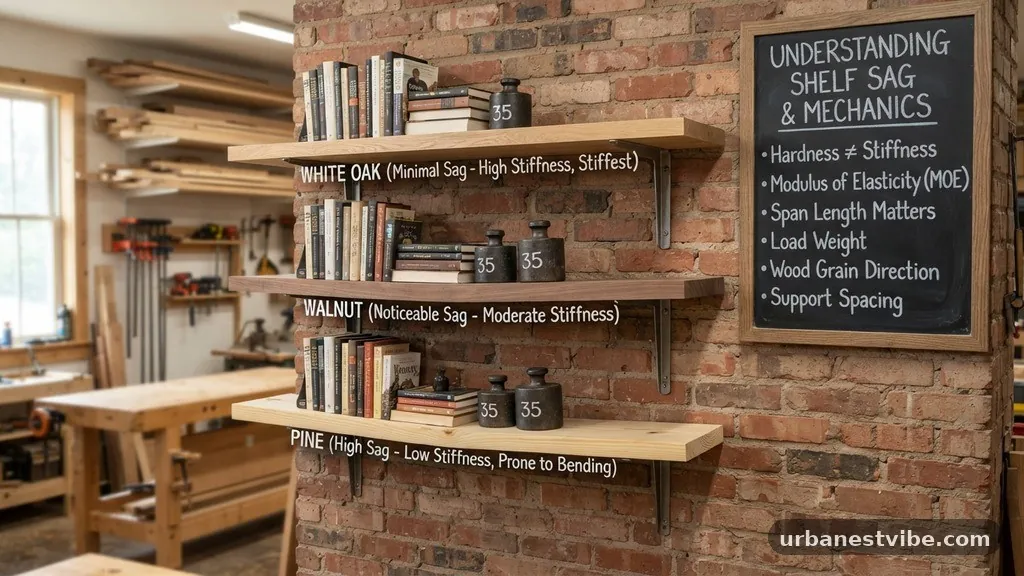
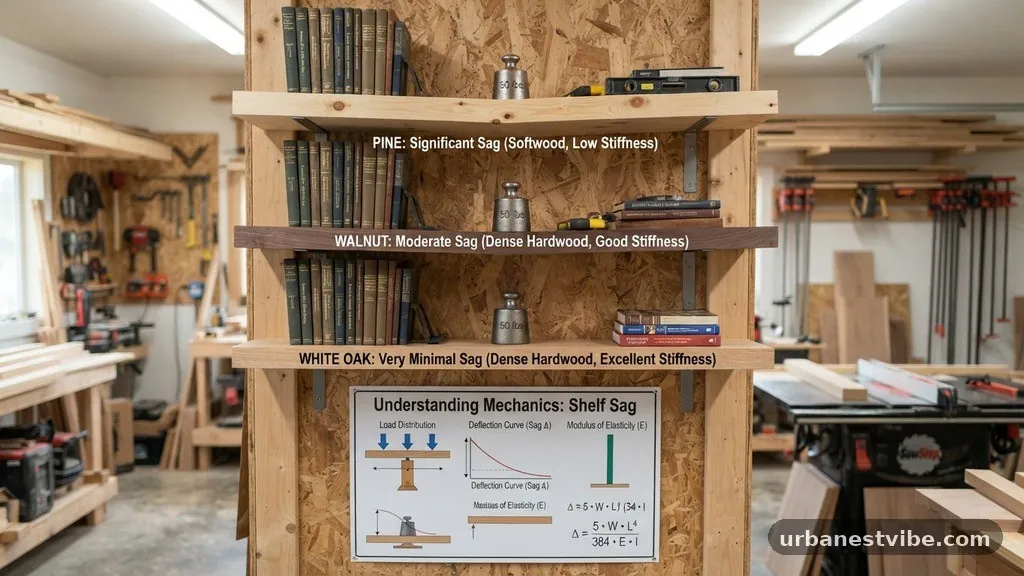
Shelf sag is not merely an aesthetic grievance; it is a structural failure caused by the wood’s inability to support a load over a specific span. When you place heavy objects on a shelf, the wood fibers are compressed on the top surface and stretched on the bottom.
If the material lacks sufficient stiffness, these fibers permanently deform, resulting in a visible bow. This phenomenon is measured by the Modulus of Elasticity (MOE), a technical value that describes how much a piece of lumber resists bending.
To prevent this, you must account for the distance between your brackets. A shelf spanning three feet will sag significantly more than one spanning two feet, regardless of the species. Many DIY enthusiasts mistakenly rely on thickness alone, assuming a thicker board is always stronger.
While thickness helps, the internal density of the wood is the primary defense against gravity. When selecting the best Solid Hardwoods (White Oak vs Walnut vs Pine) for Non-Sag Shelves, you are essentially shopping for a high MOE rating.
Evaluating White Oak for Structural Rigidity
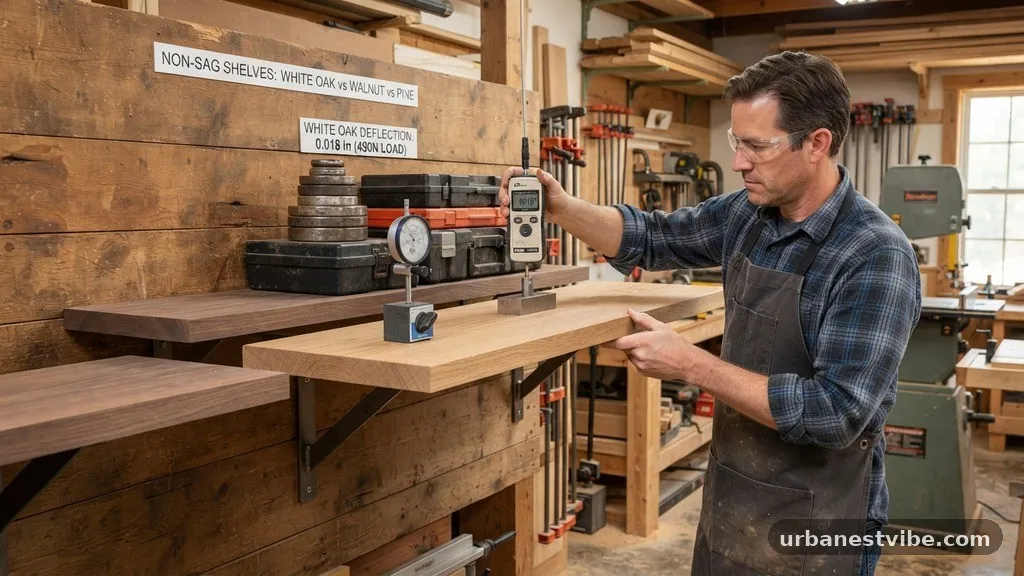
White oak is widely considered the gold standard for heavy-duty shelving due to its exceptional hardness and density. It is a closed-grain wood, which makes it remarkably stable and less prone to warping when compared to softer varieties.
Its structural integrity is so high that it is frequently used in boat building and flooring, environments where durability is non-negotiable. If you are constructing a library or a kitchen pantry intended for heavy stoneware, white oak is an elite candidate.
The primary advantage of white oak lies in its resistance to deflection. It maintains its shape even when under constant pressure from heavy loads.
Because it is a dense hardwood, it also holds fasteners and brackets with superior grip, ensuring your shelving system remains securely attached to the wall. While it is more expensive and physically heavier than pine, the investment pays off in a shelf that remains perfectly level for decades.
The Aesthetic and Structural Balance of Walnut
Walnut is a premium choice that offers a sophisticated dark finish along with respectable structural properties. It is slightly softer than white oak, yet it is still classified as a hardwood with sufficient density for most residential shelving applications.
Designers often choose walnut for modern furniture and high-end cabinetry because of its rich, chocolate-colored heartwood and straight grain patterns. When used in floating shelves, it provides a luxurious appearance that requires very little finishing beyond a simple oil or wax.
When using walnut, it is important to be mindful of its span. Because it is not as stiff as white oak, you should avoid extremely long, unsupported runs. If you want to use walnut in a large closet, consider adding a center bracket or a decorative cleat to distribute the weight.
This approach allows you to enjoy the beauty of the wood without compromising the structural lifespan of the unit. It remains a top-tier choice for those who prioritize design as much as functionality.
Why Pine Often Falls Short for Long Spans
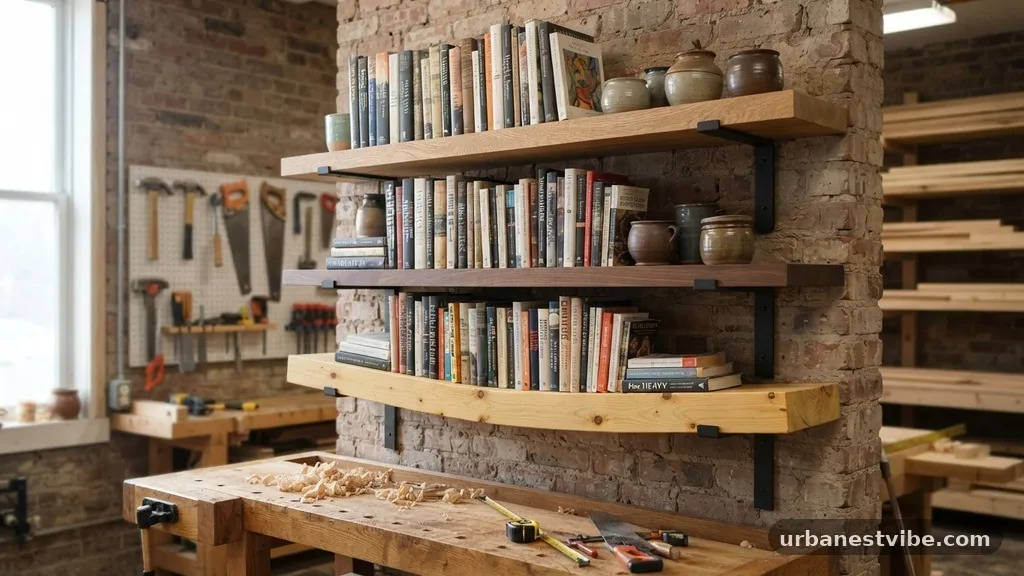
Pine is a softwood, which fundamentally changes how it behaves under load. While it is incredibly affordable and easy to source at any local lumber yard, it lacks the dense cell structure required to resist sagging over time.
Pine is prone to “creep,” a process where the wood slowly deforms under a steady weight. If you install pine shelving in a workshop or garage, you will likely notice a downward curve within a few months, especially if the shelves are loaded with heavy items.
There are specific scenarios where pine is acceptable, such as in short, decorative nooks or light-duty storage areas where the load is minimal. However, for a serious project, relying on pine often leads to frustration.
If you must use pine for budget reasons, you should significantly increase the thickness of the board or add a solid wood face frame to the front edge. This “nosing” adds a vertical element that dramatically increases the stiffness of the shelf, though it still won’t match the performance of a true hardwood.
Comparing Density and Load Capacity
To determine the best Solid Hardwoods (White Oak vs Walnut vs Pine) for Non-Sag Shelves, look at the Janka hardness test results. This industry standard measures the force required to embed a steel ball into the wood.
White oak ranks near 1,360 lbf, whereas walnut sits closer to 1,010 lbf, and most common pine species like Eastern White Pine are significantly lower, often falling below 400 lbf. This massive disparity explains why oak shelves feel solid while pine shelves feel flexible.
When calculating the weight of your items, always assume a higher load than you anticipate. Books, for instance, are notoriously heavy, often weighing more than kitchen appliances per square foot.
If you are building a bookshelf, prioritize white oak or hard maple over walnut or pine. By matching the wood species to the intended use, you ensure your project remains as stable as the day you installed it.
The Role of Plywood as a Reliable Alternative
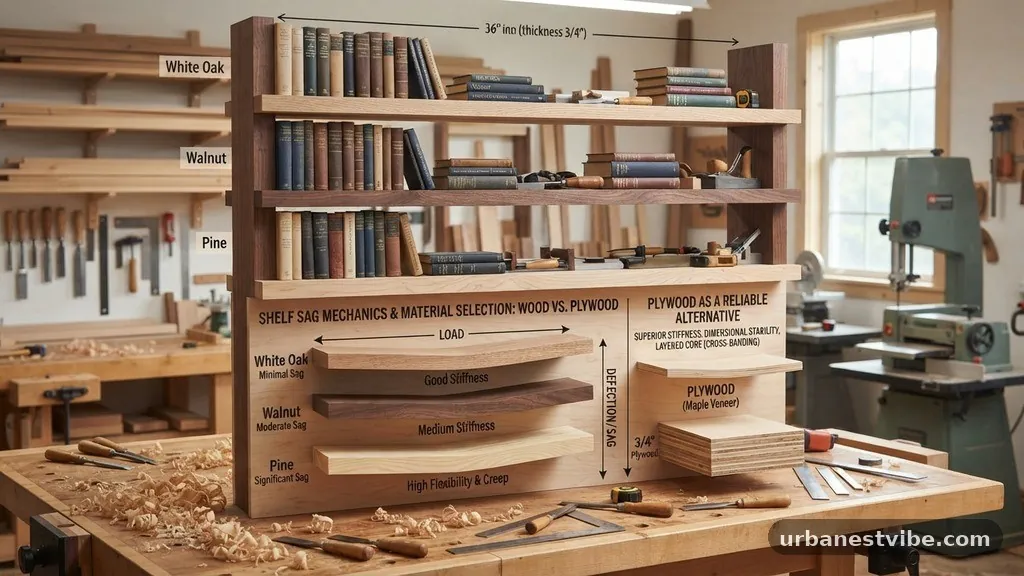
While this discussion focuses on solid wood, it is professional negligence not to mention high-quality plywood. Architectural-grade birch or oak plywood is often more stable than solid wood because of its cross-laminated construction.
Each layer of veneer is glued with the grain running in opposing directions, which locks the wood fibers in place and prevents the board from bowing or twisting. For wide cabinets or long closet runs, a 3/4-inch plywood shelf with a solid wood edge is often superior to a single slab of solid hardwood.
Many woodworkers prefer plywood for large-scale shelving because it is less affected by changes in humidity. Solid wood is hygroscopic, meaning it absorbs and releases moisture, which causes it to expand and contract.
Over several seasons, this movement can cause a solid wood shelf to develop a slight crown or cup. Plywood remains inert, providing a flat surface that won’t warp, provided it is properly supported.
Designing for Maximum Support
The way you mount your shelving is just as important as the material you choose. No matter how stiff the wood is, a shelf will sag if the distance between supports is too great.
A general rule of thumb for 3/4-inch hardwoods is to keep supports within 30 to 32 inches of each other. If you are using lighter woods or thinner stock, reduce that distance to 24 inches or less to be safe.
Consider the USDA Forest Products Laboratory research on wood properties, which highlights how moisture content and span affect structural stability. Using high-quality hardware is the final step in ensuring your shelves do not sag. Avoid cheap, plastic shelf pins that can shear under weight.
Instead, use heavy-duty metal brackets, French cleats, or dado joints that allow the shelf to be recessed into the wall or side panels. These methods transfer the load directly to the wall structure rather than relying on a single connection point.
Finishing and Moisture Protection
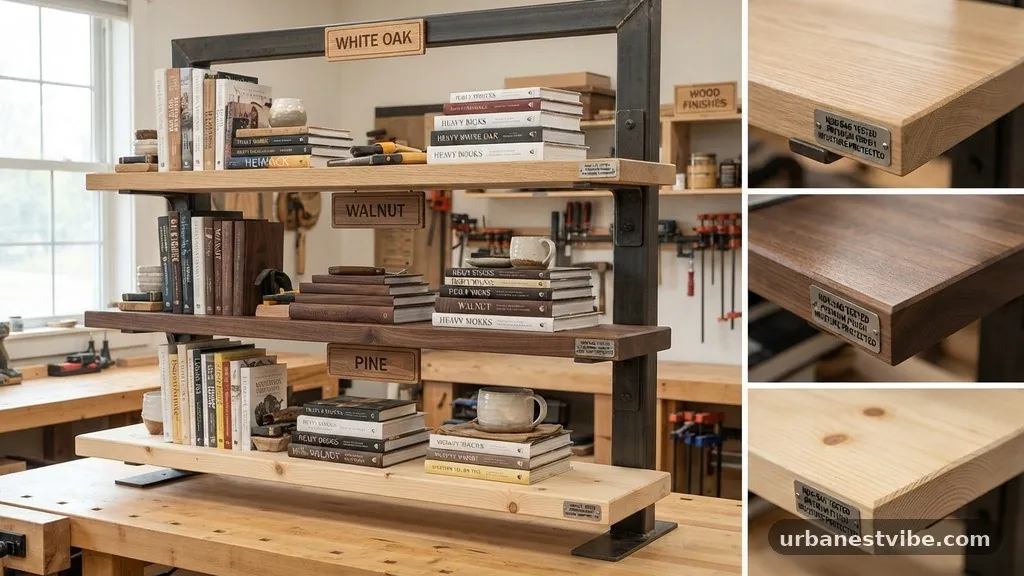
Moisture is the silent enemy of a flat shelf. If your wood is not properly sealed, it will absorb humidity from the air, which leads to swelling and inevitable warping. This is particularly true in bathrooms or near kitchen sinks.
To protect your investment, apply a high-quality finish such as polyurethane, conversion varnish, or a hard-wax oil. These finishes create a barrier that slows down the exchange of moisture, keeping the wood fibers stable.
Always finish both the top and bottom of the shelf simultaneously. If you only finish the top, the bottom will absorb moisture at a different rate, causing the board to cup.
This is a common mistake that ruins otherwise perfectly crafted shelves. Taking the time to apply even coats on all sides ensures that the wood remains balanced and flat, regardless of the ambient humidity in your home.
Common Mistakes to Avoid During Installation
The most frequent error in shelf building is ignoring the orientation of the grain. Always inspect the board for “runout,” where the grain lines run off the edge of the board rather than parallel to it.
Grain that deviates from the length of the board is a weak point where a snap or a deep bow is likely to occur. Look for boards with straight, tight growth rings, especially when selecting white oak.
Another oversight is failing to account for the weight of the shelving material itself. A thick slab of white oak is heavy; if your wall studs are not properly located, the weight of the shelf plus the books could pull the anchors right out of the drywall.
Always screw your brackets directly into the wooden studs. If the studs don’t align with your desired shelf placement, install a horizontal backing board or “cleat” across the wall to create a solid mounting surface.
Frequently Asked Questions
Is white oak really better than walnut for bookshelves?
Yes, for heavy loads like books, white oak is superior due to its higher density and stiffness. Walnut is beautiful and strong enough for lighter items, but it is more likely to deflect under the concentrated weight of a full library.
How thick should my solid hardwood shelves be to avoid sagging?
For most standard spans of 30 inches, a 3/4-inch thickness is the minimum for hardwoods. If you are using a softer wood like pine, you should increase the thickness to at least 1 inch or add a front edge stiffener to prevent bowing.
Does wood species matter more than the bracket spacing?
Both are equally critical. You can have the strongest white oak in the world, but if the span between brackets is too wide, it will eventually sag. Conversely, even weak pine can perform well if the supports are placed close together.
Can I use floating shelves for heavy storage?
Floating shelves are inherently more difficult to make “sag-proof” because they lack a visible support underneath. If you want floating shelves for heavy items, you must use heavy-duty steel rod systems that are anchored deep into the wall studs.
Why is my plywood shelf sagging when my solid wood one isn’t?
This usually happens because the plywood was not thick enough or was not supported correctly. While plywood is stable, it is not as rigid as a solid piece of thick white oak. If a plywood shelf is sagging, it likely needs a hardwood edge glued to the front to provide the necessary tension.
Final Thoughts on Choosing Materials
Selecting the best Solid Hardwoods (White Oak vs Walnut vs Pine) for Non-Sag Shelves requires a balance between your design goals and the physical limitations of the timber. White oak remains the top choice for heavy-duty applications, while walnut provides an excellent middle ground for those wanting a premium look.
Pine should generally be reserved for light-duty projects unless you plan to significantly reinforce the structure. By focusing on grain orientation, proper bracket placement, and effective moisture sealing, you can create shelving that lasts for generations without bowing.
Take your time when selecting your boards at the lumber yard. Look for straight, tight grain and ensure the wood is kiln-dried to the appropriate moisture content for your region. If you feel uncertain about the span, err on the side of caution by adding an extra support or choosing a thicker material.
Building with wood is a rewarding craft, and with these principles, your final product will be as durable as it is beautiful. Feel free to reach out if you have specific questions about your next woodworking project.