How Long Can a Floating Shelf Be Before It Needs a Center Support Rod?
Determining exactly how long can a floating shelf be before it needs a center support rod is vital for anyone planning a wall-mounted display. If you push the limits of material strength without accounting for structural physics, your shelves will inevitably sag or pull away from the wall.
By understanding the relationship between shelf length, material density, and mounting hardware, you can achieve a sleek, minimalist look without compromising safety. This article explores the precise engineering thresholds and installation techniques required to keep your shelving secure, ensuring you avoid the common pitfalls that lead to hardware failure or damaged drywall.
Understanding the Mechanics of Shelf Sag
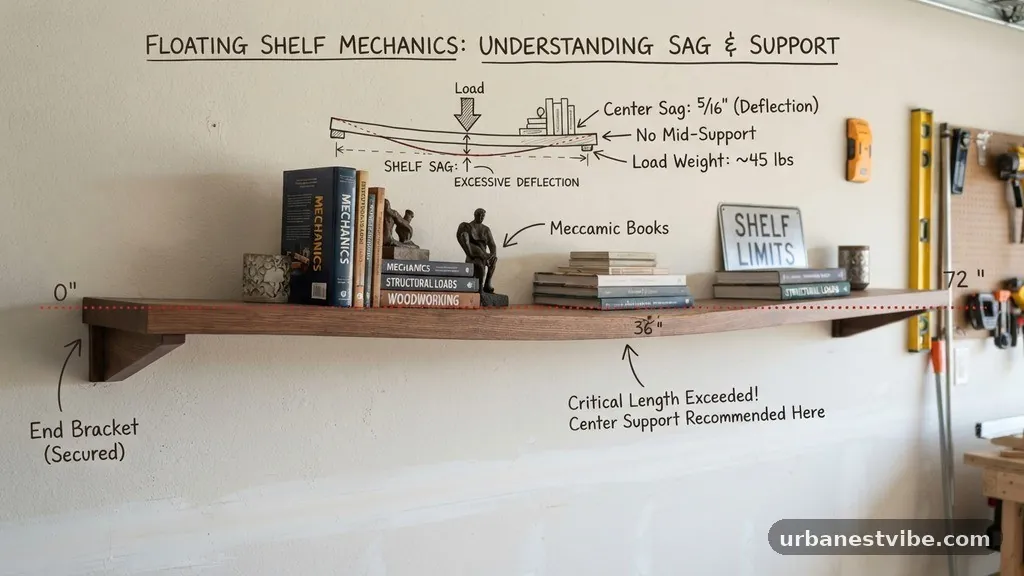
Floating shelves rely on cantilevered support, meaning the weight is held entirely by the connection at the wall. When a shelf exceeds a certain length, the force of gravity creates a moment arm that acts on the mounting brackets.
If the board isn’t rigid enough, the outer edges begin to droop. This is not just an aesthetic issue; it indicates that the internal hardware is experiencing stress that could lead to a total failure of the mounting system.
Materials play a massive role in this equation. Solid hardwood provides inherent stiffness, while MDF or hollow-core boards lack the structural integrity to span long distances without bowing.
If you are using a standard 36-inch span, a piece of solid oak might remain perfectly level, whereas a particleboard version of the same length could start to flex under its own weight. The thickness of the shelf also matters; a 2-inch thick board is significantly more resistant to bending than a 1-inch board.
The Critical Length Threshold for Standard Brackets
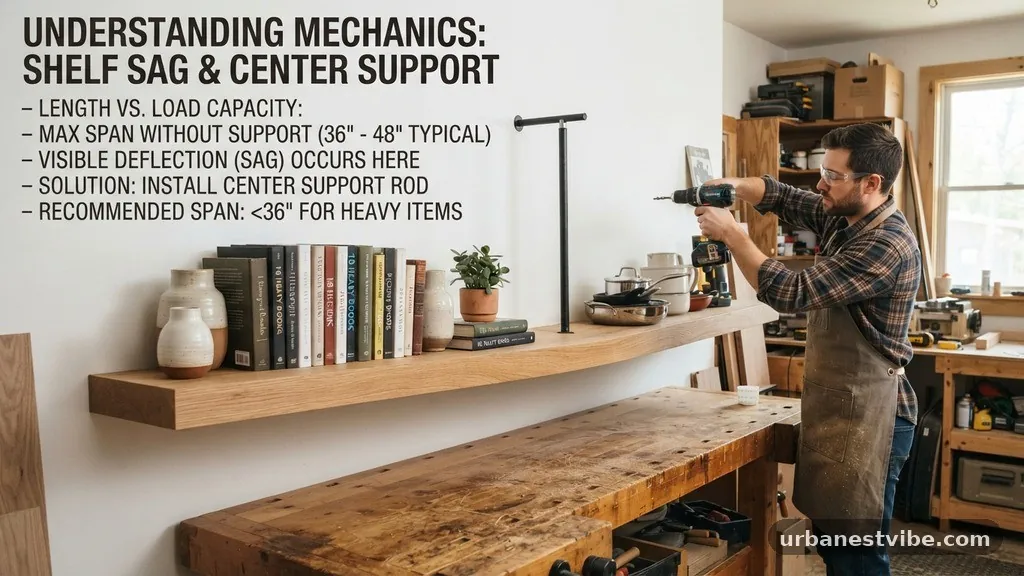
Most industry experts suggest that 30 to 36 inches is the maximum length for a standard two-bracket floating shelf setup. Beyond this 36-inch mark, you enter the territory where a center support rod or an additional bracket becomes mandatory. If you attempt to stretch a single shelf to 48 inches or more without internal reinforcement, you are almost guaranteed to see a visible sag within the first few months of use.
Common mistakes often involve ignoring the depth of the shelf. A deep shelf—say, 12 inches out from the wall—exerts much more leverage on the brackets than a shallow 6-inch ledge. When calculating your length, always factor in the depth.
If you are building a deep display for heavy books, consider adding that center support even if the shelf is only 30 inches long. It is always better to over-engineer a mount than to have a shelf collapse because the leverage was underestimated.
Evaluating Wall Material and Stud Alignment
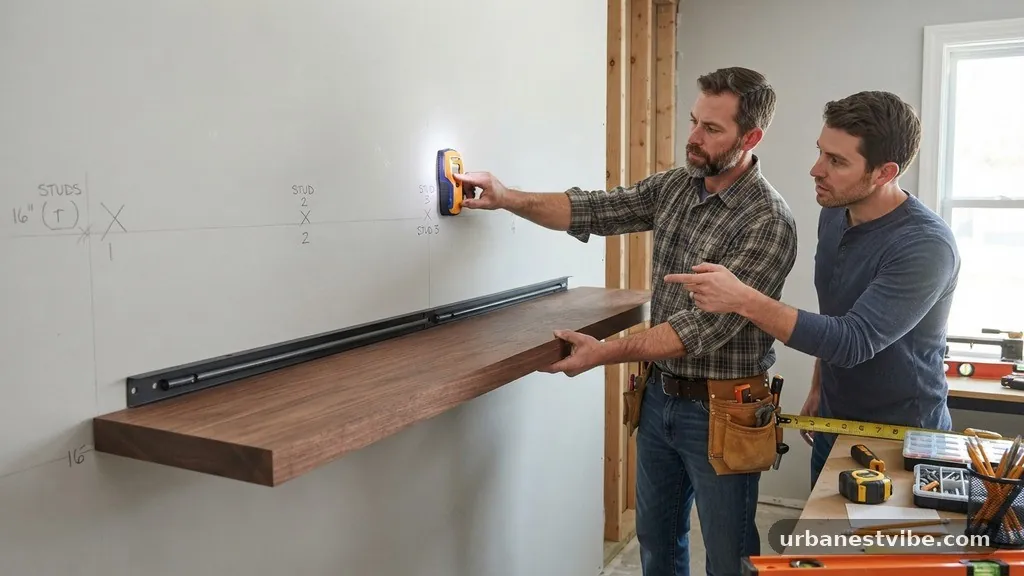
The strength of your shelf is only as good as the wall it is attached to. Floating shelves are designed to be anchored into wall studs, which provide the only reliable support for heavy items. If your desired shelf length doesn’t align with your stud spacing, you are forced to use drywall anchors, which are rarely sufficient for long, heavy spans.
When you are planning your installation, use a high-quality stud finder to map out the framing behind your drywall. If the studs are 16 inches apart, a 32-inch shelf fits perfectly across three studs. If your ideal shelf length is 40 inches, you will likely only catch two studs, leaving the center unsupported.
This is precisely where the need for a center support rod becomes apparent. Without it, the middle of the shelf will lack the connection required to prevent it from pulling away from the wall or sagging under moderate loads.
Choosing the Right Mounting Hardware
Not all brackets are created equal. Many of the “floating” hardware kits sold in big-box stores are made of thin steel that flexes under pressure.
For a shelf that is nearing the length limit, you need heavy-duty steel rods or a specialized floating shelf bracket system that features a backplate. This backplate spreads the load across a larger surface area on the wall, which is essential for preventing the mounting holes from widening over time.
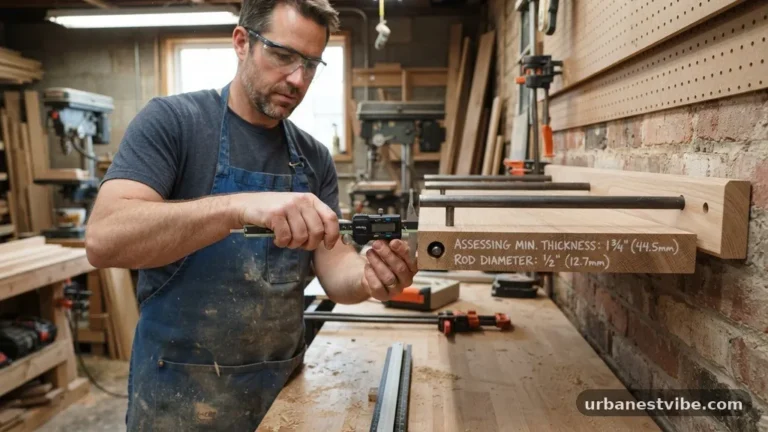
You can find more detailed information on structural integrity and hardware standards by visiting the International Association of Certified Home Inspectors for guidance on load-bearing residential installations. When selecting your hardware, look for rods that are at least 1/2 inch in diameter. If your shelf is particularly long, ensure the rods extend at least two-thirds of the way into the shelf depth to provide maximum leverage resistance.
The Impact of Weight and Load Distribution
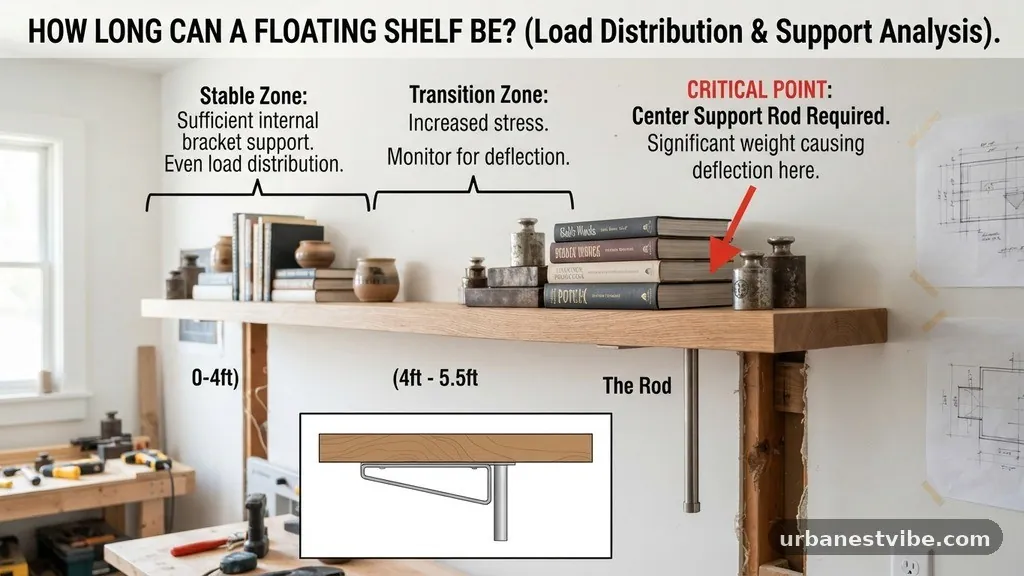
The total weight of the objects you intend to store is just as important as the physical length of the board. A 48-inch shelf holding lightweight decorative items might remain level, while the same shelf holding a collection of heavy hardback books will sag almost immediately. Always calculate the maximum potential load in lbs before deciding on your mounting strategy.
A good rule of thumb is to assume that any shelf over 36 inches will require a center support rod if you intend to store anything heavier than lightweight picture frames. If you are using your shelves in a kitchen or home office, the load is typically higher, which necessitates more frequent support intervals. Never exceed the weight capacity recommended by the manufacturer of your bracket kit, as this is usually calculated under ideal laboratory conditions that don’t account for real-world vibrations or fluctuating humidity.
Calculating the Deflection of Different Materials
Wood behaves differently based on its species and moisture content. Solid hardwoods like walnut, oak, or maple are dense and resistant to deflection.
They are the ideal choice for long floating shelves because they maintain their shape under stress. Conversely, softer woods like pine or manufactured products like MDF are prone to “creep,” which is the gradual deformation of a material under a constant load over time.
If you are determined to have a long shelf without a center support rod, you must increase the thickness of the material. A 2.5-inch thick slab of hardwood will support a much longer span than a 1-inch board.
However, even with thick material, you will eventually reach a point where the weight of the shelf itself contributes to the sag. For any shelf exceeding 4 feet in length, it is standard practice to incorporate some form of central support to ensure long-term stability.
Installing a Center Support Rod
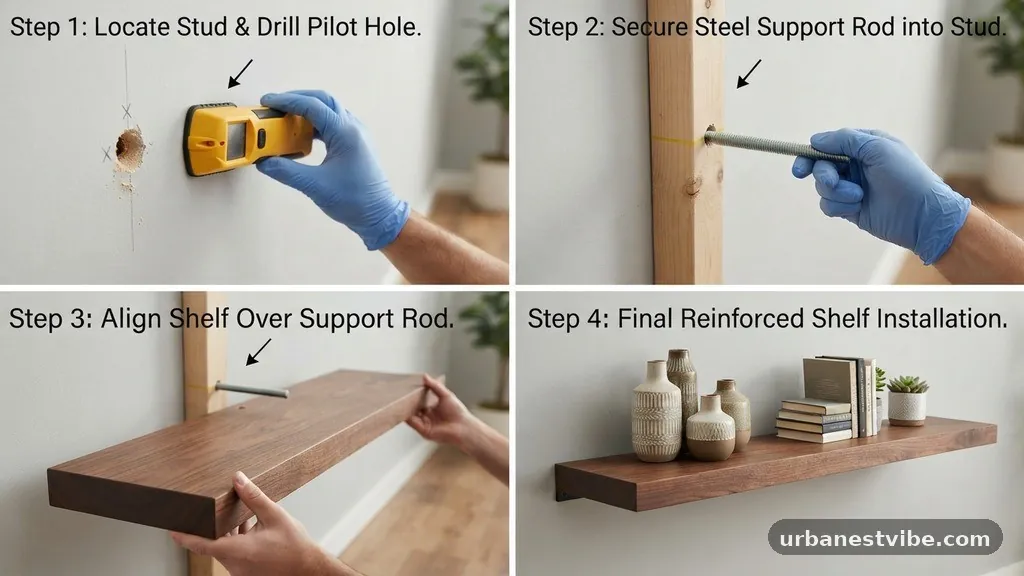
If you have determined that your project exceeds the recommended length, installing a center support rod is a straightforward process. You can use a decorative corbel, a minimalist steel rod, or even an L-bracket hidden behind a book or decor item. The goal is to provide a point of contact that transfers the weight directly to the wall studs, effectively splitting the span in half.
To install this correctly, mark the center of your shelf span and ensure that the support aligns with a wall stud. If the center of your shelf lands between studs, you have two options: either shift the shelf slightly to align with a stud or install blocking inside the wall.
Installing blocking requires cutting into the drywall, but it is the most professional way to ensure your center support is rock-solid. Never rely on drywall anchors for the center support of a long shelf, as the vertical tension will eventually cause them to fail.
Common Mistakes to Avoid During Installation
The most frequent error is assuming that all wall surfaces are perfectly flat and square. Walls often have subtle bows or imperfections that cause the shelf to sit at an angle.
When installing a long shelf, use a long level to ensure the mounting plate is perfectly horizontal before you secure it. If the bracket is slightly tilted, the outer end of the shelf will be noticeably lower, making the sag seem much worse than it actually is.
Another common mistake is neglecting the clearance between the back of the shelf and the wall. If there is a gap, the shelf will naturally want to lean forward, putting extra strain on the mounting rods.
Use shims if necessary to ensure a tight, flush fit against the wall. A tight fit increases friction and stability, which helps the shelf hold more weight without requiring constant adjustments or hardware tightening.
Maximizing Capacity with Smart Design
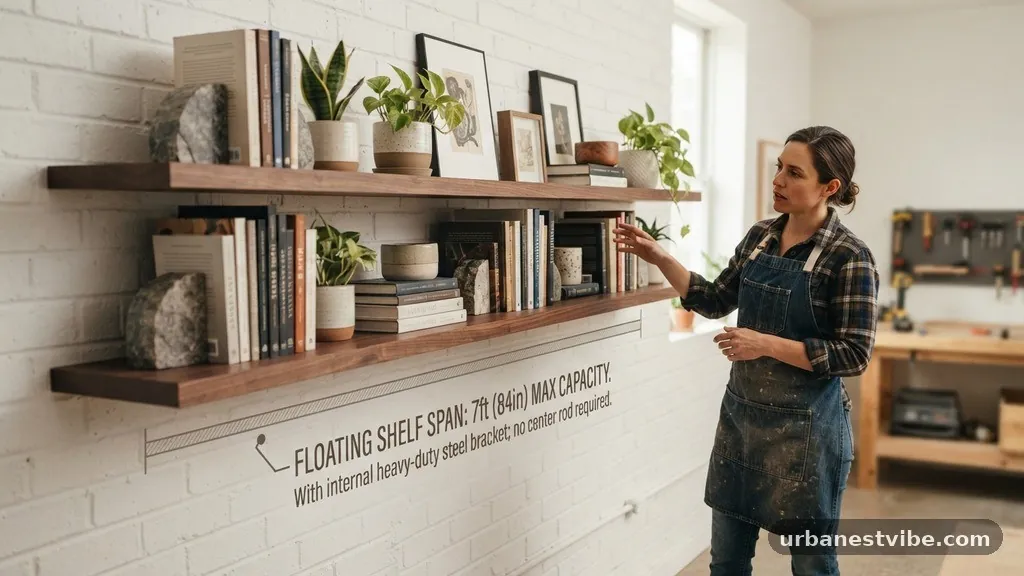
If you want to avoid the look of a center support rod, you can design your shelves in a modular fashion. Instead of one continuous 8-foot shelf, consider two 4-foot shelves mounted side-by-side. This approach allows you to use the standard two-bracket system for each section, ensuring maximum strength without needing to bridge a massive gap.
Modular designs also provide more flexibility when it comes to organizing your space. You can stagger the heights or leave small gaps between the shelves to create a custom look that feels intentional rather than forced.
If you do choose a modular approach, ensure that you are mounting each section into at least two wall studs. This provides the best possible foundation for holding heavy loads while maintaining that clean, minimalist aesthetic you desire.
How Temperature and Humidity Affect Your Shelf
Environmental factors are often overlooked when considering the longevity of a wall-mounted display. Wood is a hygroscopic material, meaning it expands and contracts based on the humidity levels in your room.
In a bathroom or kitchen, where humidity levels can fluctuate wildly, a long shelf will experience significant internal stress. This expansion can loosen mounting screws and cause the shelf to lose its level.
If you are installing shelves in a high-humidity environment, use a high-quality sealant or finish to protect the wood. Additionally, check your mounting hardware every few months to ensure that the screws remain tight. If you notice the shelf beginning to sag during a particularly humid season, it is a clear sign that you need to add a center support rod to compensate for the reduction in the material’s structural rigidity.
Frequently Asked Questions
Can I use a floating shelf for heavy books without a center support?
You can, provided the shelf is relatively short—ideally under 30 inches—and mounted directly into multiple wall studs with heavy-duty steel brackets. For anything longer or deeper, the weight of a full row of books will cause significant deflection, so a center support is highly recommended to protect your wall and your belongings.
What is the best material for a long floating shelf?
Solid hardwood is the superior choice because of its density and resistance to bending. Species like white oak, hard maple, or walnut provide the best structural performance. Avoid using hollow-core or thin MDF for long spans, as these materials have very little internal strength and will sag under their own weight even without added items.
How do I know if my shelf is sagging because of the wall or the hardware?
If the shelf is pulling away from the wall, the issue is typically the mounting hardware or the connection to the studs. If the shelf is level at the wall but drooping at the outer edge, the issue is the material itself being too thin or the span being too long. In either case, adding a center support rod is the most effective fix.
Can I install a center support rod after the shelf is already mounted?
Yes, it is possible, though it requires precision. You will need to find the stud, drill into the shelf, and install a support that matches your existing aesthetic. It is much easier to plan for the center support during the initial build, but a post-installation support can save a shelf that has already begun to bow.
Does the thickness of the shelf change how long it can be?
Absolutely. A 2-inch thick shelf is significantly stiffer than a 1-inch thick shelf. By increasing the thickness, you increase the “moment of inertia,” which makes the board much more resistant to bending. While a thicker shelf allows for a slightly longer span, you will still hit a limit where a center support rod becomes necessary for safety.
Conclusion
Determining how long can a floating shelf be before it needs a center support rod is a balance of physics and material science. While a 36-inch span is generally considered the outer limit for standard hardware, your specific project requirements regarding weight and material density may necessitate support sooner. By prioritizing stud-mounted connections, choosing rigid materials, and being honest about the load you intend to place on your shelves, you can create a beautiful and functional display that lasts for years.
If you find your shelf approaching that critical length threshold, don’t hesitate to incorporate a center support. It is the most reliable way to ensure your installation remains secure, level, and safe for your home. Take the time to measure your stud spacing and assess your weight needs today to build with confidence.